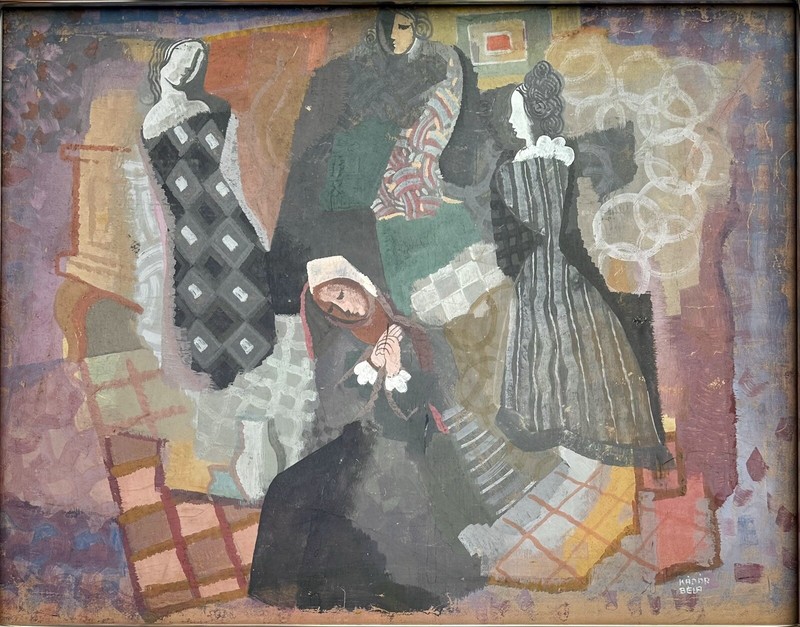


Bela Kadar gouache painting of a family "Bernarda" 1932 ~ 31x40
Béla Kádár (Hungarian, 1877-1956)Bernarda gouache on board, signed l.r., original gallery label on verso from Tibor de Nagy Gallery, New York visible image measures approximately: 40" W x 31 1/4" Hframe measures approximately: 42 5/8" W x 33 3/4" H Please note that shipping charges are inclusive of insurance, payment processing (if paying by check or cash, processing fee will be refunded) and carrier fees. If local pickup is selected and if applicable, payment processing fee will still be assessed and due. About Béla Kádár Bela Kádár is one of the most famous representatives of the Hungarian avant-garde of the first half of the 20th century. Kádár was born in Hungary on April 7, 1877 to a working-class Jewish family. Due to his father’s early death, Kádár was apprenticed as an iron-turner after completing only six years in primary school. He eventually began his career as an artist by painting murals in Budapest. Like many of the artists of his day Kádár was drawn to Paris and Berlin, and by 1910 he had visited both cities twice. He studied at the Budapest Academy of Fine Arts directed by Jószef Rippl-Rónai. Kádár was attracted to the Impressionist painters and the Vienna secessionists, and after a visit to Berlin in 1912, his painting was influenced by Expressionism and Futurism. When the First World War erupted, Kádár joined up voluntarily in 1914 and, despite the inevitable halt this meant in his career, by 1918 his work was displayed in a one-man show in Budapest. In 1921, he exhibited at the Hevesi Salon together with a fellow Hungarian artist, Hugo Scheiber. The two of them represented a divergent offshoot of the ideas championed by the magazine MA and its editor Lajos Kassák. Whereas MA advocated a Constructivist approach, Kádár remained in touch with the visible world, which he interpreted from an Expressionistic viewpoint close to the work of Marc Chagall. Even so, some of his works display a clear interest in geometricisation. While Kádár was in Berlin his earlier expressionist style changed from emotionally charged and powerful graphic tone (work before the 1920’s) to a more romantic mood. Elements of folk tale and fantasy gained prominence whilst his subject matter became more narrative. Kádár notably employed aesthetics from a range of movements, such as Constructivism, Cubism, and German Expressionism, and focused on traditional Hungarian folklore to inspire his imagery. Whether depicting scenes of abstracted figures, objects, landscapes, or interiors, his work features bright, jewel-toned palettes and a fractured approach to rendering space. In 1923, Kádár showed his paintings in Berlin at the invitation of Herwath Walden. Walden was an important figure in the German avant-garde, being the publisher of the journal Der Sturm, which featured the works of Franz Marc, Paul Klee, Wassily Kandinsky, Marc Chagall and Oskar Kokoschka. During the group exhibition at Walden's gallery with other artist's of Der Sturm, Kádár met Katherine Dreier whose Societe Anonyme was instrumental in bringing the work of the European avant-garde to New York. With her help two major exhibitions of his work occurred at the Brooklyn Museum of Art in 1927. Following the end of the Second World War, which Kádár survived in the Jewish ghetto in Budapest, he produced a book with illustrations on the atrocities committed by the Nazis. Kádár’s works are in many private and public collections including the Hungarian National Gallery in Budapest, Jewish Museum in New York, Thyssen-Bornemisza National Museum in Madrid. Bela Kadar died on December 31, 1956 in Budapest, Hungary.
Specifications
| All Returns Accepted | ReturnsNotAccepted |
| Artist | Bela Kadar |
| Size | Large |
| Signed | Yes |
| Period | Art Deco (1920-1940) |
| Material | Board |
| Framing | Framed |
| Subject | Family |
| Type | Painting |
| Year Of Production | 1932 |
| Original/Licensed Reproduction | Original |
| Theme | People |
| Features | One of a Kind (OOAK) |
| Production Technique | Gouache Painting |
| Time Period Produced | 1925-1949 |
A nice touch is how the board’s edge is finished, adding a clean, professional look.