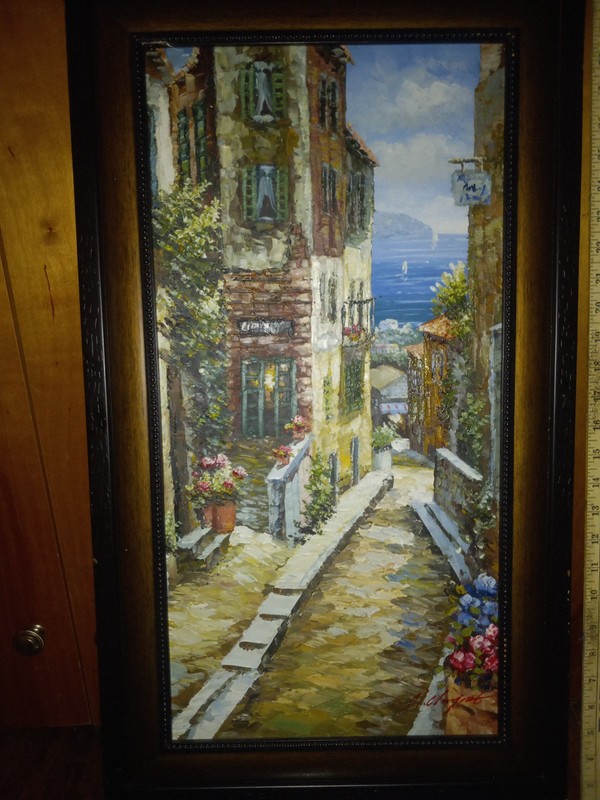




ANTONIO DI VICCARO VINTAGE ITALIAN MODERN VILLA OCEAN LANDSCAPE OIL PAINTING 80s
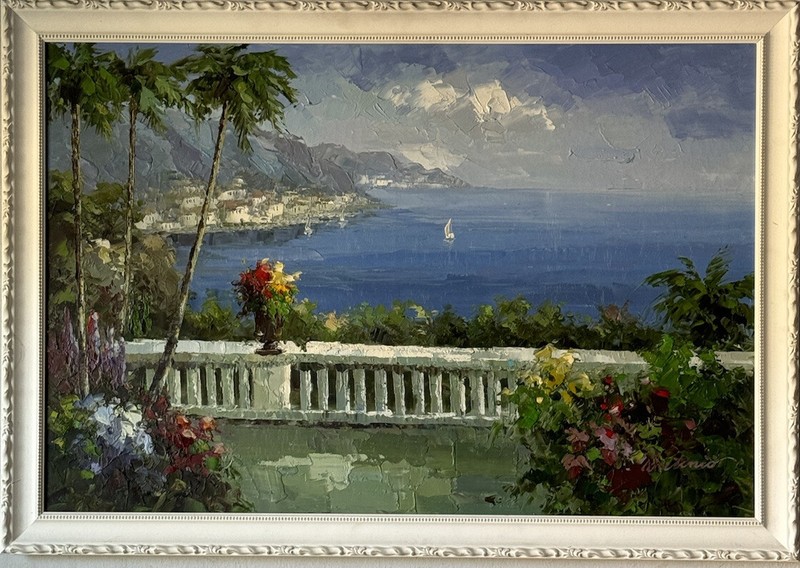
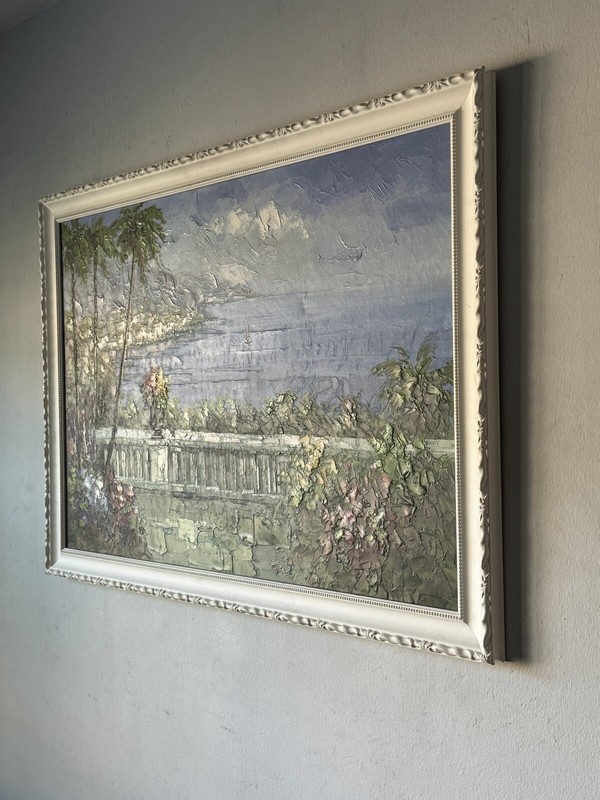
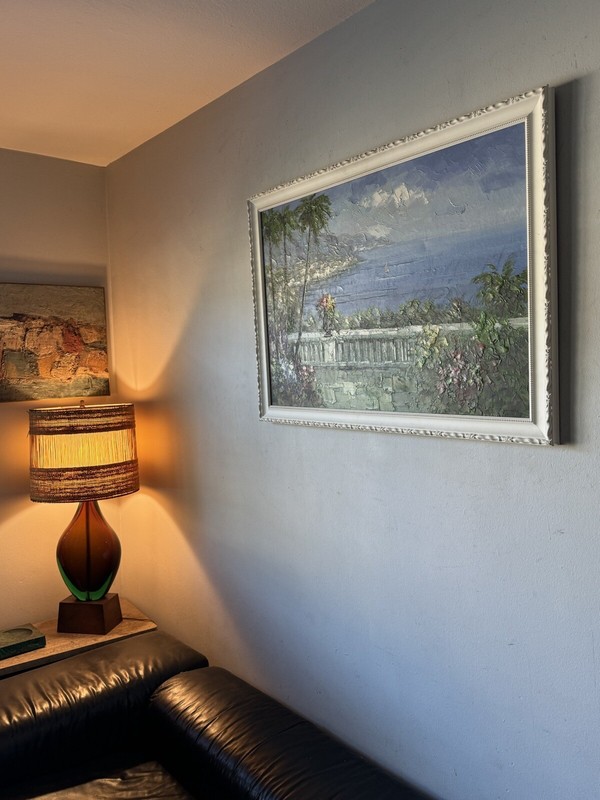
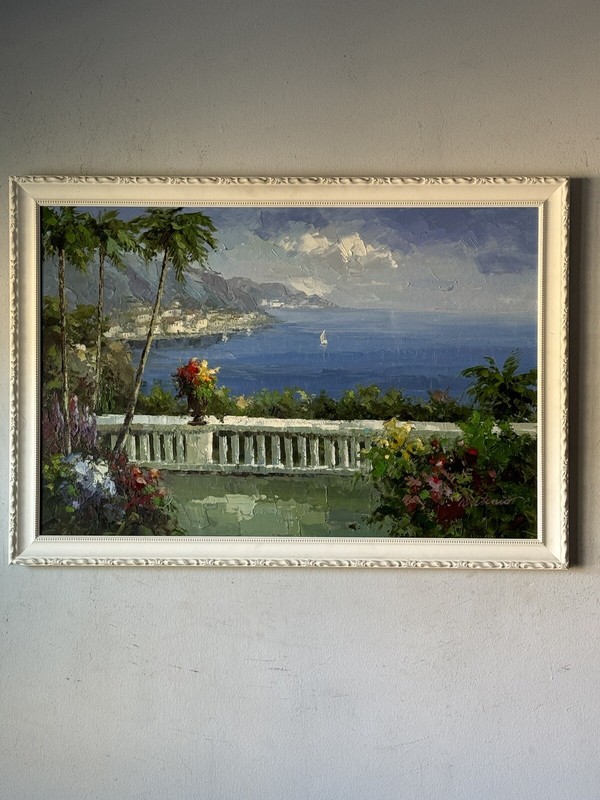
CAPTIVATING ANTIQUE ITALIAN MODERN LANDSCAPE IMPRESSIONIST OIL PAINTING ON CANVAS BY INTERNATIONALLY KNOWN ITALIAN PAINTER ANTONIO DI VICCARO.(Italian b.1935). THE POET OF COLOR. THIS WORK DEPICTS A GORGEOUS ITALIAN VILLA COURTYARD SCENE OVER LOOKING A TRANQUIL BLUE OCEAN—AN ELEGANT GARDEN COURTYARD BALCONY OVERLOOKING THE OCEAN AND ROLLING HILLS ADORNED WITH TERRACOTTA ROOFED VILLAS. A BOAT DOCK AND LUSH GREEN EXOTIC PLANTS ADD A SENSE OF RICHNESS TO THE SCENE. THIS PAINTING IS MASTERFULLY RENDERED WITH PAINSTAKING ATTENTION TO DETAIL, INVITING THE VIEWERS TO IMMERSE THEMSELVES IN THE BEAUTY OF THE ITALIAN COUNTRYSIDE AND THE ENDLESS ALURE OF THE TRANQUIL OCEAN. SIMPLY AMAZING. SIGNED BY ANTONIO VICCARO IN THE LOWER RIGHTHAND CORNER. IT DATES AROUND THE 1970s. GOOD OVERALL CONDITION. MILD PAINT LOSS , AS SHOWN. IT DOES NOT DETRACT FROM ITS BEAUTY IN ANY WAY. DIMENSIONS: 28”H x 40”W Antonio di Viccaro (late 20th century) was active/lived in Italy. Antonio di Viccaro is known for Painting. In the ’60s, Antonio Di Viccaro found his dimension in society. In this period, he experimented with materials, using stucco tinted with solid colors and a pallet knife to create his paintings. The colors were almost monochromatic, his house shades of grey and brown. Di Viccaro’s first works were already subjected to an internal logic. He organized quadrates of color, modulated by the thickness of the stucco in a metric way so that when he viewed them as a whole, they created a unique, unpredictable optic-chromatic effect. Recurrent characteristics emerge in the plaster, not to be mistaken; however, it is far from thematic repetition because the polychromatic stucco on the almost monochromatic surface is charged with shadows, secrets, and ever-changing tensions. In the ’70s, the party with colors began. Di Viccaro painted perfectly readable landscapes with traces of controlled geometry and a liberal, more figurative expression. At the end of the ’80s, after success abroad, the artist had accumulated a mass of work. Having painted for over thirty years and dedicated himself to studying color, his style evolved, and he became one of the “New Italian Landscapists.” At this point, Di Viccaro wanted to verify his style. He researched a series of new directions, bringing back to his works a unique richness and reconfirming the validity of his results during the preceding period. Antonio Di Viccaro remains true to his style and ever-deepening expressiveness acquired through the necessity to increase the intensity of colors and light in his paintings continually. Antonio Di Viccaro paints sun-drenched landscapes, the moods of the sea, and summer days bursting with color. His world has not changed but has been enriched, as well as his style. Using his experience with materials, in his works, he creates a tension that identifies the observer’s physical sensations. Di Viccaro experiences nature like a visceral love. His paintings show the complete pleasure of the one who immerses himself in a sea of trees and leaves, of luxuriant blossoms and flowering vines, and participates in the luscious, tumultuous, continued life of vegetation. Di Viccaro ‘s painting gently adapts to this impetus of existential identification with the scenery. Landscapes of Venice or the Amalfi Coast dissolve into an emotion of colors. As in a field, the colors of the flowers, the blazing sun, and the reflections of the sea merge and blend to become an unrepeatable moment of life, as do the elements in Di Viccaro ‘s paintings. Sea and vegetation are inexplicably fused into a dense fabric of Turkish reds, violets, greens, yellows, blues, whites, and pinks that swell and luxuriantly beat. Di Viccaro lives the experience of the landscape from the inside, with sentiments that can not be contemplated but become moments of poetry. Wedges of colors create a chromatic rhythm, and forms bathed in limpid southern light become almost symbolic under his masterful strokes. Di Viccaro provides admirable examples of interpretation in a series of landscape themes that have become objects of meditation, stimulated by the artist’s lyrical and emotional foundation. Reality is translated into paintings as constructions, as volumes that occupy space and find in harmony between form and atmosphere their reason for being. To make concrete the essence of a landscape, to transfer it into a painting, it is necessary to possess objective y in all its aspects. Only then does it become pliable and can be transformed into images-figurations of a new, wholly transformed reality. From this relationship with the truth, Di Viccaro creates his realism, which constructs images equivalent to his way of experiencing life and transfers them into a new landscape dimension. Antonio Diviccaro was born in 1935 in Castelforte, Italy, where, according to the artist, his artistic career began at 11. Diviccaro attended the prestigious School of Fine Arts in Italy, and at the age of 23, he held his first personal exhibition in the “Circolo Artistico di Arezzo.” The Circolo Exhibition, which was enthusiastically received by the Italian art community, would later furnish Diviccaro with the opportunity to exhibit in the United States, where he found great success in Los Angeles, Boston, and Chicago. In Italy, Diviccaro is one of the few artists who use the “palette knife” technique. A lover of the Italian landscape, Diviccaro often returns to his native town, Castelforte, or travels to the Island of Capri, Costa Amalfitana, Positano, the Gulf Islands, Florence, and Venice to capture the splendid views. The cerulean skies, the brilliant white stucco houses, and the magenta flowers cast a spell on the viewer’s mind, transporting them to the most beautiful places on Earth. “I paint simply because I love painting,” says Diviccaro, “I began when I was a child, and therefore, I love art as much as I am an optimist.” This optimism has earned him the title “the poet of color” and critical acclaim worldwide. Divicarro first displayed his work in 1957 in San Giovanni (Firenze). Since then, he has continued showing his art in numerous successful one-person exhibitions in his native Italy and worldwide in cities such as Chicago, New Orleans, Washington, Las Vegas, San Francisco, and New York. One who sees far the first time Antonio Di Viccaro’s work is instantly attracted by the luminosity that emanates from his paintings. His paintings, made up of soft blues, lily whites, pastel greens, hot reds, and delicate pinks, imprint themselves on the mind in an instant, like a flash of lightning that illuminates, at the moment, the deep darkness of a stormy night. But this immediate effect is no doubt disadvantageous for the artist. Think of a beautiful woman who suddenly appears: she is fascinating, elegant, refined, and she dazzles her mind. Only with a second, more attentive glance can we separate the elements from the whole and appreciate her eyes, smile, and expression. And so it is with Di Viccaro’s paintings. By looking at them, we can appreciate their general context, wide and deep at the same time. Color is a useful, but not determinative, factor in evaluating Di Viccaro ‘s work. His colors, often spread with a spatula, are worm and soft and vary according to the atmosphere he wants to create in magical places such as Positano, the Amalfi Coast, and the Gulf Islands; colors harmonize with the whole work. In harmony with other components, such as perspective and proportion, colors give life to a piece of art. Likewise, it is Di Viccaro ‘s sensitivity, united with his technique and experience, that completes his work. This marks a natural good taste and an extended study in a specific field. Di Viccaro comes from a historically rich land that has produced prestigious schools of art, such as the Posillipo and the Resina, and great landscape painters. Therefore, his work should be complete. They are imbued with a delicate lyricism. The places “come alive”; one ” feels” in these paintings a pulse of life, a sense of warmth and harmony that goes beyond the ancient, often academic and ordinary works of minor painters. I have noticed that Di Viccaro pays diligent attention to all the details of his work. I had the chance to see some of them in Venice. Here, the atmosphere is slightly different, but not only because of the natural change of the light refracted from the still water of the canals. The whole context of the paintings is heterogeneous as if the history of the mysterious buildings, bridges, and channels took root in the soul of the artist, and he, receiving their message, transferred it to the can vas with intimate poetry. These are my first impressions, the emotional reactions I use to clarify my opinion of an artist. On the other hand, an art critic must first know how to grasp all of the more or less aspects of the painting and then explain the differently perceived contents. Speaking about Di Viccaro’s paintings seems to be simple: they’re “readable,” they’re well done, and they have nothing symbolic, no obscure meanings or allegories to be clarified. One critic wrote of Di Viccaro’s work: “There is no need to go into a critical analysis of prospective and proportion, but rather to be happy with the beauty that emanates from it. A theory was very respectable but totally different from my own. It’s a problem of interpretation. I search for the primary motives behind the origin of Di Viccaro ‘s art to demonstrate that its simplicity is not due to a superficiality or a lack of themes or knowledge. On the contrary, his art is hard-fought. An athlete barely touches the ground as he runs; he seems to fly, yet he exerts incredible farce. And so it happens with Di Viccaro. Simplicity, in our strange world, is often associated with facility, but it is not good. I certainly do not mean to have discovered Di Viccaro ‘s qualities. He is a successful artist who received awards and recognition worldwide, conquering the American market, where his work is appreciated and justly valued. Di Viccaro’s relationship with Aldo Caner, owner of art galleries in Capri, Positano, San Gimignano, and Florida, undoubtedly played a role in his success. Miniaci and Di Viccaro’s relationship goes beyond a simple relation between art merchant and artist: theirs is more like the rapport between the Bernardo hermit crab and the sea anemone who act in mutual harmony much more than cooperation or alliance, but a way of life in which one of them is in need, and at the same time, is helpful to the other one. Thanks to this symbiotic relationship, Di Viccaro’s work is also appreciated in the New World. In the past, Di Viccaro has experimented with abstract art. Perhaps he wanted to demonstrate his unquestionable technical and imaginative capacities. However, his present style is his authentic style. Di Viccaro, to be sure, loves his world of painting and gives back to this world in a way that adheres to his ideas and principles. He paints landscapes and seascapes well known throughout the world, but he filters them through his personality, creating fantastic scenes that are always full of humanity. P Bourget said: “Live as you think. Otherwise, sooner or later, you will think about how you lived”.
Specifications
| All Returns Accepted | ReturnsNotAccepted |
| Artist | Antonio Di Viccaro |
| Unit Of Sale | Single Piece |
| Signed By | Antonio Viccaro |
| Size | Large |
| Signed | Yes |
| Material | Canvas |
| Item Length | 40 in |
| Region Of Origin | Italy |
| Framing | Framed |
| Subject | Landscape |
| Type | Painting |
| Year Of Production | 1980s |
| Original/Licensed Reproduction | Original |
| Item Height | 28 in |
| Theme | Art |
| Style | Impressionism |
| Features | One of a Kind (OOAK) |
| Production Technique | Oil Painting |
| Country/Region Of Manufacture | Italy |
| Culture | Italian |
| Item Width | 40 in |
| Handmade | Yes |
| Time Period Produced | 1980-1989 |
I appreciate how the canvas material adds a subtle texture that makes the painting feel alive.